Aanhik – The Nath Tradition of Daily Worship
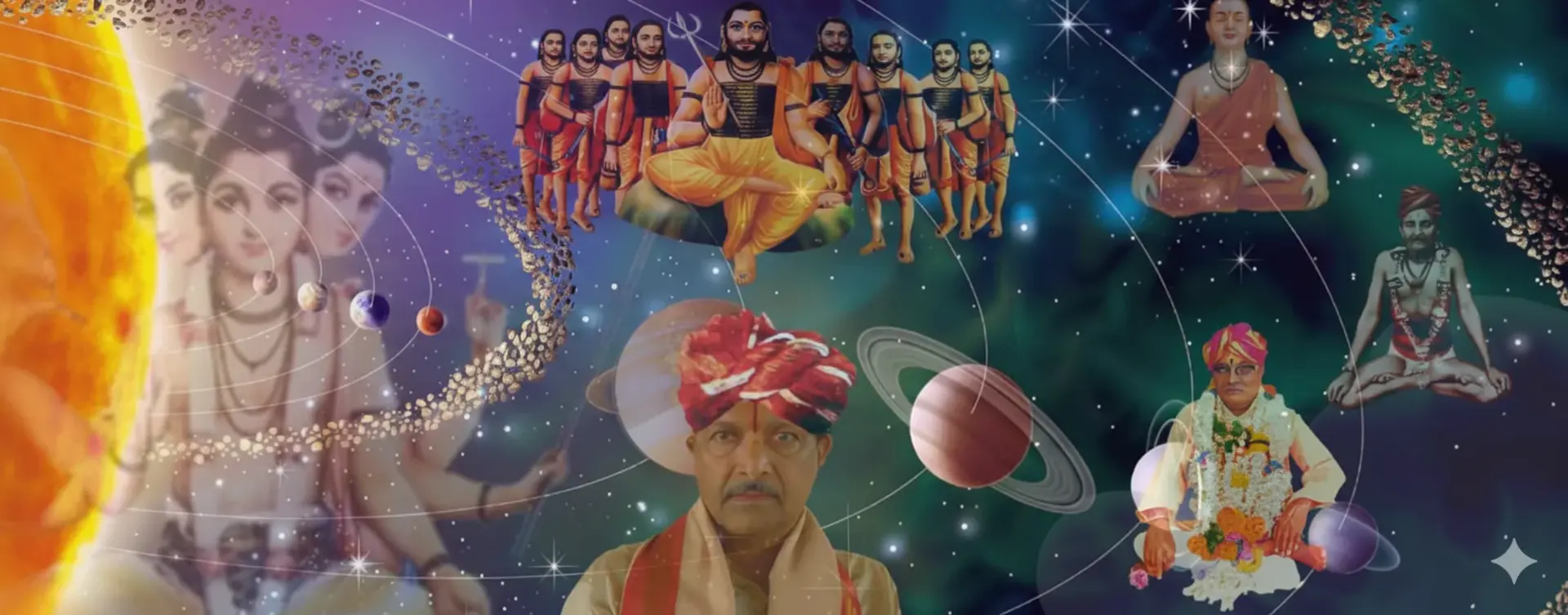
In the Nath tradition, the Guru’s method of worship is unique. Ordinarily, we imagine worship as rituals done before images or idols of deities, but Nath worship is cosmic in nature. It is based on the movement of the Sun, planets, stars, and constellations, and on the functioning of the Five Great Elements — Earth, Water, Fire, Air and Space — all of which are central to human life.
Sadguru Vyankatnath Maharaj performed *Aanhik* every morning and evening with unwavering discipline. *Aanhik* simply means daily sacred worship, but in the Nath tradition its depth is vast.
The Method of Aanhik
On the ritual platform (*chaurang*), two oil lamps were placed at the corners and next to them two ghee lamps, with a camphor lamp arranged in the middle for the final arati. At the center was a special sacred seat, not for an idol, but for a cosmic Navagraha diagram shaped like a circular chart. This *Navagraha Pouchee* symbolized the essence of the universe.
Sadguru Maharaj wore sacred garments (*sovale*) and began Aanhik after applying *Ramanandi* tilak. The *pouchi* was ritually bathed (abhishek) with mantras from the Dattatreya tradition, Rudra, Atharvashirsha, Shabari Devi, protective Kavachas and other sacred texts. At times he performed the Aanhik in solitude, behind closed doors. During worship, *gandha* (sandal paste) was prepared and infused with mantra vibrations; these sacred sandalwood balls were later used to strengthen a person’s nature, correct planetary conditions or fulfill Guru’s spiritual intentions. Many disciples have experienced their powerful effect.
Today, Shri Narendranath Maharaj continues this same traditional form of Aanhik. Its impact is profound: it influences the environment and reshapes the inner condition of everyone present. Simply being physically present reduces inner faults and disturbances over time.
Subtle and Spiritual Effects
During Aanhik, all deities and cosmic energies are believed to be present in subtle form. The sacred *gandha* acts as a divine catalyst, and many disciples feel the Guru travels through subtle realms and returns. The *teertha* (consecrated water) used during worship also carries extraordinary influence.
In modern language, Aanhik becomes a moment of inner and outer spiritual examination, where the Guru instantly perceives the devotee’s mental, emotional and karmic disturbances. After completing the Aanhik with his *sankalpa*, disciples perform Guru Padya Puja, followed by traditional arati and prayers. The Guru distributes *teertha* and *prasada*, and when needed, performs subtle or extraordinary acts for individual benefit.
Importance of the Sun in Nath Tradition
In this daily worship, the Sun is the central deity and all others take their position around it. In Nath philosophy, the Sun is the atma (soul) of all beings and the direct giver of life.
Due to Earth’s rotation, the Sun appears to travel, creating two great transitions:
- Uttarayana (Jan 14–July 16), when the Sun moves from the southeast to the northeast
- Dakshinayana (July 16–Jan 14), when it moves from the northeast to the southwest
Two key turning points are Makara Sankranti and Karka Sankranti, both deeply significant in Nath tradition. On these days, a special Surya-Sankraman Havan is performed. The sacred ash (vibhuti) from this havan enhances mantra power, strengthens spiritual practices, energizes divine tools (shastra-astra) and offers spiritual protection.
Although many practices remain within the lineage, their purpose is always the welfare of humanity. Various sacred havans are performed throughout the year, each aligned with cosmic timing and intended for public upliftment and universal well-being.