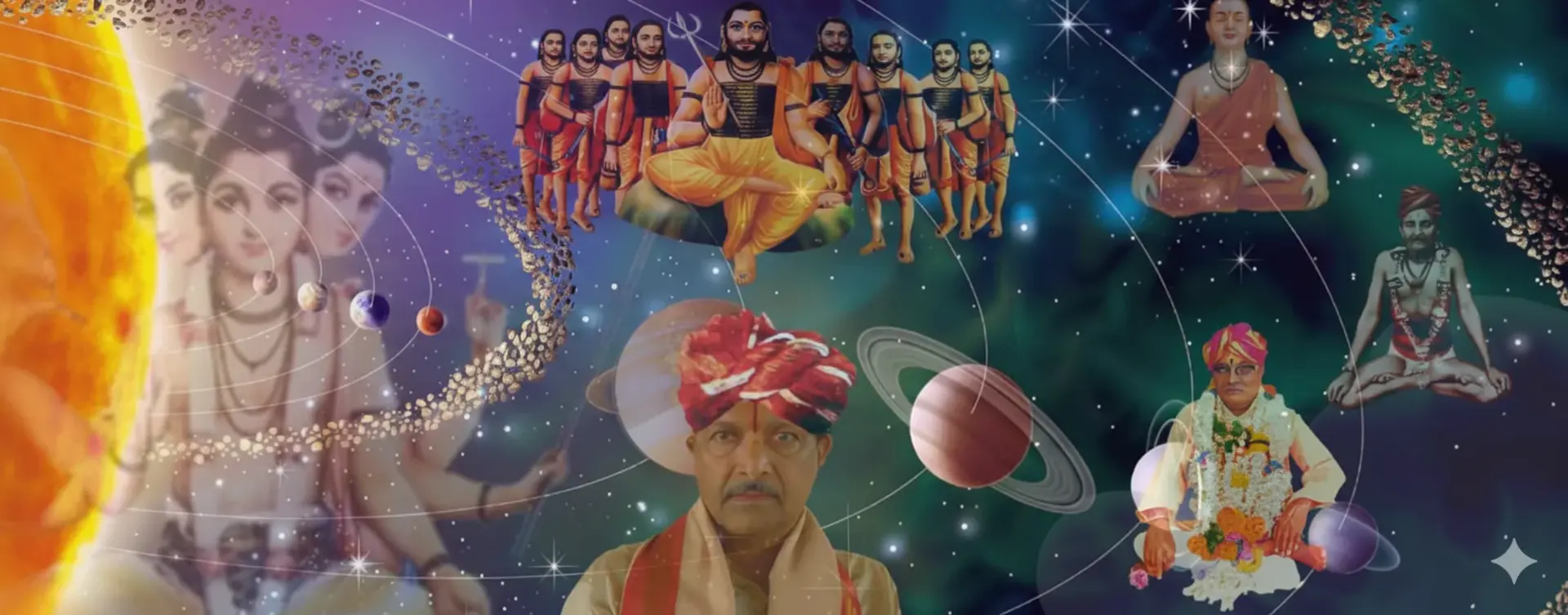
Vyankatanath Maharaj in the Navnath Tradition
Sadguru Vyankatanath Maharaj — my own Sadguru — worked lifelong within the Navnath Sampradaya through an unbroken Guru–disciple lineage. Considering his personality, power, greatness, teachings, and thoughts, devotional songs were composed in his honor, published under the name *Swanand Sudha*. When Maharaj was in the body, we disciples and gurubandhus would sing these bhajans in his presence. These bhajans are all siddha bhajans — each one carrying its own history and spiritual depth. Each song teaches how a person should live, how one should act, how one should shape oneself, what spiritual knowledge is, how to attain it, how to manage worldly affairs, and how to develop oneself. Every song contains some form of teaching.
Kakada and the Practice of Bhajan
Kakada is the first section, sung before sunrise. In Kakada, the dawn and the early morning nature are described beautifully — the stillness, the purity, the subtle energies. When one performs worship or spiritual practice at that time, its impact becomes very deep. These songs explain how to perform practice, who the Guru is, what the Guru’s power is, and how nature itself assists the Guru. By listening or chanting these songs daily, spiritual truths begin to arise naturally.
Similarly, bhajans are arranged for the evening, and each weekday has its own designated bhajan. Each stanza teaches something unique. Spiritual understanding arises without effort — without one realizing when it happened. The effect of these bhajans does not remain limited to the mind; it influences the soul, the body, one’s energetic system, and even daily behavior, patterns of thinking, efficiency of work, decision-making, and future development. A wholesome transformation begins, and slowly, the Guru’s grace descends.
Transformative Power of Bhajan
One bhajan states: *“Isha maatre haardi tujhya, rog-vyaadhi samasta hote; Praapti bhajan karata, tej ye nitya nitya.”* Meaning: Just by sincere chanting, diseases and sorrows fade, and the seeker gains inner light day by day. Merely by bhajan, life’s grief, poverty, difficulties, and worries diminish. Paths open for all that one inwardly seeks. As one chants daily, different methods unfold naturally — transformation happens in the body, the inner system, and one’s spiritual constitution.
Another bhajan says: *“Nityaniyamane bhajan kare jo, une na tyaa bhaase; Shrinathanche vachanachi, aise khote ho kaise.”* Even when Maharaj was alive, countless devotees personally experienced that regular bhajan removed obstacles and brought peace and clarity. Capacity for action improved, decisions became stronger, and many previously impossible things began to succeed. A hungry person receives food, a student receives knowledge — such is the fruit of these bhajans.
Vyankatanath Maharaj: A Siddha Purusha
All these hymns belong to that siddha purusha, Vyankatanath Maharaj, who carried forward the Navnath lineage that began with Matsyendranath, continuing unbroken until 1993. Throughout this lineage, extraordinary events have occurred effortlessly. The Nath Yogis held mastery over nature — over the five elements: earth, water, fire, air, and space. Their daily lives were simple, their speech direct and pure, but their inner power was vast.
Just as Dnyaneshwar Maharaj was an avatar of Vishnu yet lived simply — no one could suspect he was a divine incarnation — similarly, Vyankatanath Maharaj too was an incarnation of Vishnu. He lived like an ordinary person, appeared simple, but his power was immense. Whatever he willed — whatever arose in his mind — manifested effortlessly. Things happened merely through his intent. Such was his divine personality.