The Place of Human Beings in the Universe
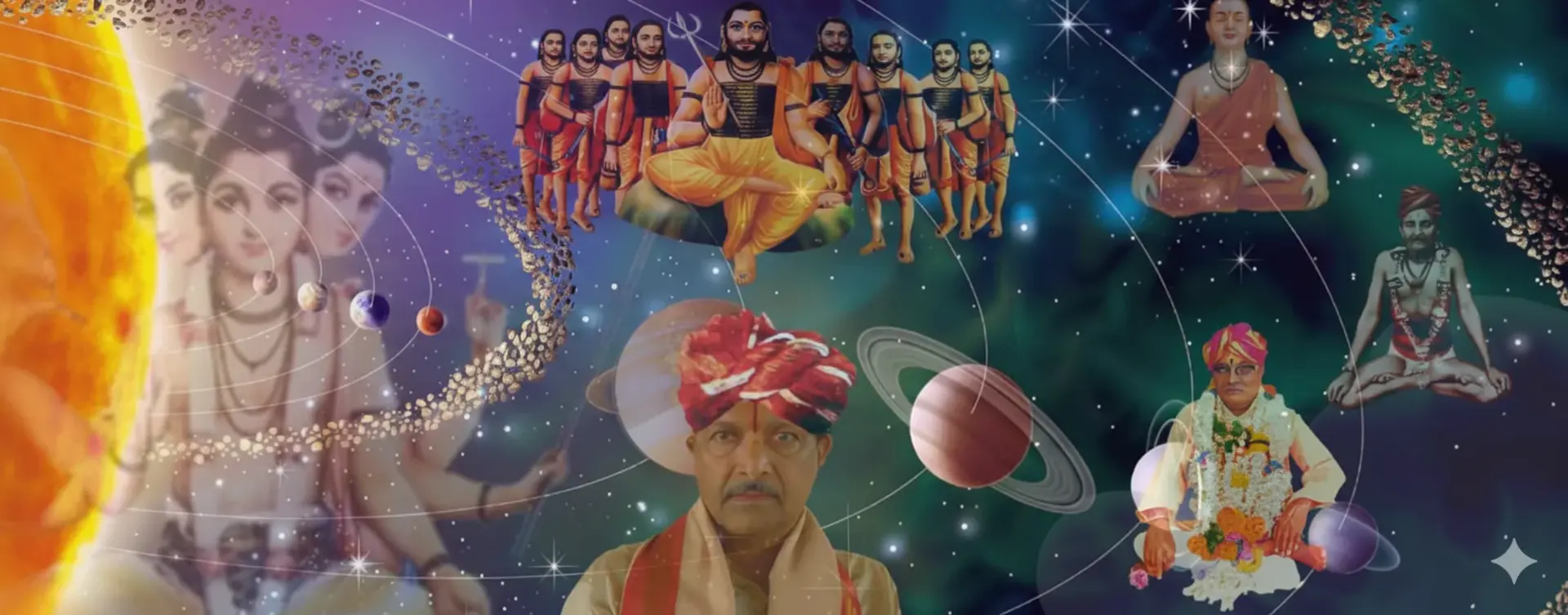
To understand the position of human beings in this vast universe, one must try to see from the perspective of the Creator. If we look into Vedic history, we learn that there was once a time when darkness alone existed. There was no sun, moon, stars, constellations, nor earth, water, fire, air, or space. Only a limitless void covered in absolute darkness. This is not imagination — it is described in the Rigveda. A mysterious, invisible power existed in that infinite void. From this power, in due course, the Vedas emerged. From the Vedas manifested Lord Vishnu. From the navel of Vishnu arose Brahma, and through the combined will of Brahma–Vishnu–Mahesh, the universe was created. Mountains, rivers, living beings, and all forms of nature came into existence. This entire universe runs with perfect coordination, as if automatically.
Why Human Life Is Considered Special
Among all beings, human life holds a unique place because humans are the most evolved and have the capacity to unite with the Divine faster than any other creature. What does the Creator expect from human life? Just as the power that created the universe can also dissolve it back into formless darkness, it must be understood that whatever the Creator wills is what happens. No being can alter universal laws. When nature becomes furious — earthquakes, floods, storms, avalanches — the world trembles and human power becomes helpless. No science or technology can stop such events. These experiences show that all of creation, including human life, is part of the cosmic play designed by Brahma, Vishnu and Mahesh.
The Real Game of the Universe
The cosmic game is simple: when a being frees itself from lust, anger, greed, pride, attachment and jealousy, the soul becomes uplifted and attains Ātmounnati (self-elevation). At that point, the soul becomes one with the Creator. In this process, no single deity is the focus. Responsibility rests entirely on the individual’s discretion, purity, and spiritual evolution.
What Is Ātmounnati (Self-Elevation)?
Nath Shaktipeeth has published a scripture titled Ātmounnati, which explains these principles. *Ātmounnati Sādhana* is not a religious ritual. It is not worship of a deity, mantra, or stotra. It is a pure spiritual discipline for inner evolution. Whether one believes in God or not is irrelevant. Nothing is asked from God, so nothing is expected in return. Faith or disbelief — both are equally acceptable for this sādhana.
Why Ātmounnati Is Needed
Every human faces difficulties, suffering, failures and pain. This sādhana helps reduce karmic burdens, dissolve the influence of the ṣaḍ-ripus, purify body, mind and soul, harmonise the five elements, improve destiny, remove unfavourable karmic patterns, and develop peace, clarity, intelligence and stability. It strengthens both mental and spiritual power and prepares the soul so that divine grace can flow easily. Every being is made of the five great elements, each carrying positive and negative aspects. These qualities unconsciously affect life. Ātmounnati helps neutralise negative elemental influences.
Growth of the Soul
As one continues this sādhana, karma becomes stronger and purer, the soul evolves upward, and life becomes filled with enthusiasm, clarity and capability. When the soul becomes spiritually refined, Guru’s grace comes easily, and God’s grace follows naturally. Until the soul evolves, it continues to suffer dissatisfaction, restlessness and inner turmoil.
The Fruit of This Sādhana
Traditional verses describe that the grace of Brahma, Vishnu and Mahesh will descend; the seeker will receive the service and blessings of the Sadguru; misfortunes will dissolve; the five elements will become favourable; planetary influences will change; and life will move toward peace and contentment. Through continuous purashcharanas, one understands spirituality, develops true wisdom, and through hearing, contemplation and reflection, the meaning of life becomes clear. Therefore, every human should practice Ātmounnati Sādhana and experience its transformation.