Thrown From a Moving Train
We often believe that whatever is impossible for human beings becomes possible for God. Yet yogis — though born human — achieve extraordinary capabilities through disciplined practice, inner purity, and the grace of a true Guru. No siddhi comes automatically. Every realized Yogi earns it through effort, tapas, and surrender. This means that an ordinary person, under a Sadguru’s guidance, can rise to extraordinary levels.
Just as a student becomes skilled by learning from a teacher, in the same way, a seeker living near a Sadguru, serving him, learning from him, and absorbing his presence slowly transforms from ordinary to enlightened.
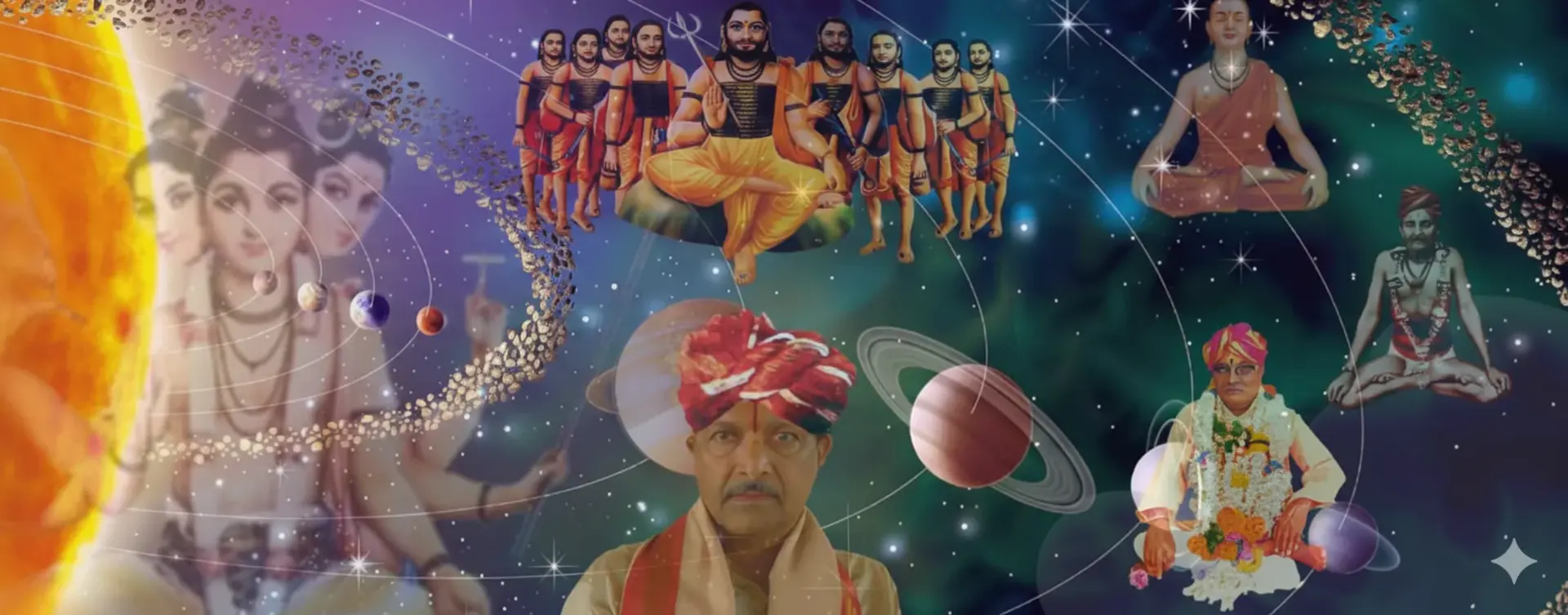
When Vyankatnath Maharaj (later known as Yogabhyananda) was barely 10–12 years old, his Guru Madhavanath Maharaj separated him from worldly life and took him to the Himalayas. There, many yogis met him according to Madhavanath’s spiritual design, training him in secret sciences and deep yogic disciplines. Through intense practice he became a master of Yoga Vidya and earned the title Yogabhyananda. His abilities were such that an ordinary person would be stunned.
By 1936, at only 32 years of age, Madhavanath Maharaj declared that Vyankatnath had been fully tested — spiritually, mentally, emotionally — and entrusted him with the entire Nath Sampradaya mission before taking Samadhi. One of these tests involved a wooden seat embedded with iron nails pointed two inches upward; he was asked to sit in Padmasana on this nail-seat. Vyankatnath sat calmly in deep absorption, unhurt and undisturbed. It echoed the ancient test where Machhindranath planted a long metal spike and commanded Gorakshanath to sit on its sharp tip in Padmasana for days — a true historic event, not myth.
After passing numerous such trials, Vyankatnath Maharaj was established as a Siddha Nath and began his Guru-appointed work.
The Train Incident
When Maharaj’s son “Baba” (Mangalnath) was around 12 years old, father and son often travelled together for Nath work. In the 1950s there were no rickshaws or taxis, and even bullock carts were not always available, so most travel happened on foot. To reach Nagpur, they first had to walk from Devgaon-Rangari to Lasur station, around 5 km away. The train at Lasur stopped for barely one minute. Missing it meant waiting an entire day for the next one.
One day they reached just as the train had halted. While they rushed toward it, the train began to move and quickly gathered speed. Missing it would disrupt Maharaj’s entire schedule, and many devotees in Nagpur were waiting. For any ordinary person, boarding that speedily departing train — along with a child and heavy luggage — was impossible.
In that critical moment, Maharaj shouted:
“Sambhālo! I am throwing the boy!”
He swung his son in a swift circular motion and threw him toward the moving first-class compartment. He then threw the luggage. Exactly as he intended, the man standing at the compartment door caught the boy perfectly, then caught the bags. Maharaj himself leapt and boarded the moving train effortlessly.
What appears impossible or reckless in ordinary thinking was performed with flawless precision — because this was not ordinary action, but yogic mastery. Yogis operate under a different order of perception, intuition, and control.
Those who lived near him saw countless such events. Some witnessed; some understood; some simply received blessings without knowing how. But those who served him, learned from him, or even merely saw him from afar were indeed extraordinarily fortunate.
For Narendra (Naren), who later continued the Nath tradition under Maharaj’s guidance, this was the fruit of many lifetimes — to learn karma, uplift others, and walk the path shown by his Sadguru.