Madhavanath’s Field of Work – Devgaon Rangari
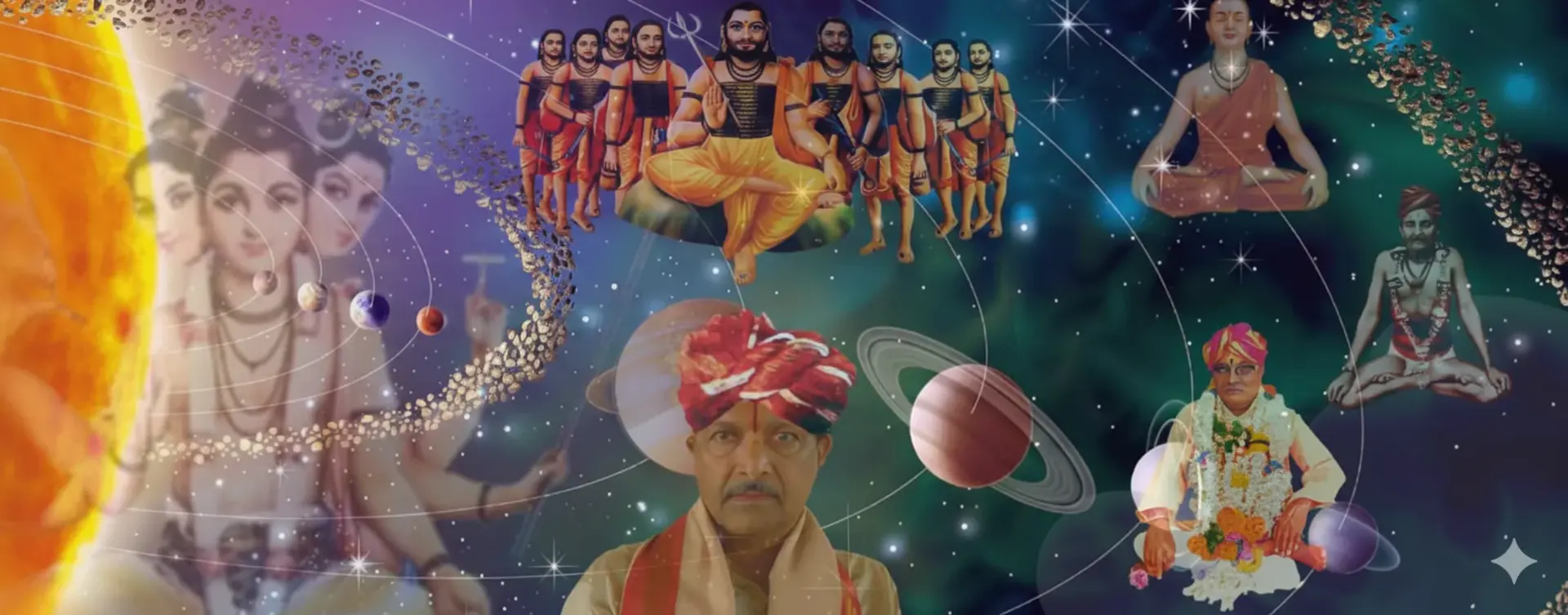
Following the divine indication personally given by Lord Balaji to Shevat Giri, Madhavanath Maharaj travelled step by step until he finally reached Devgaon Rangari. Lord Balaji Himself guided Madhavanath and brought him to Devgaon, just as He had once shaped the sacred design of the traditional temple at Chitrakoot. Keeping that divine pattern in mind, Madhavanath personally created the plan for the Devgaon temple and completed its construction.
At Devgaon, many deities appeared in symbolic ways and established their presence in the form of self-manifested idols. Through this, Devgaon naturally became a powerful spiritual centre for the Nath tradition. Madhavanath performed the consecration (pran-pratishtha) of all these divine forms Himself. After leaving Chitrakoot, Madhavanath brought the full spiritual power of that place and established it in Devgaon in 1901. For the rest of his life, he continued the Nath tradition’s work from Devgaon.
Before taking samadhi, Madhavanath Maharaj personally handed over the responsibility of the Guru’s work and the newly established spiritual seat at Devgaon to Vyankatnath Maharaj. After serving 11 years at Chitrakoot, Madhavanath left in 1890 and spent 12 more years in unknown places, moving across many pilgrimage sites. Finally, as per Balaji’s command, he established the Devgaon temple in 1902 and restarted the lineage’s work there with renewed strength.
For generations, the Nath tradition had functioned from Chitrakoot, but Madhavanath could serve there only eleven years. Eventually he realised that Chitrakoot had lost its earlier power and that the time had come for the spiritual centre to change. This reflects the deepening effects of the Kali Yuga. Nath Geetanjali (their devotional songs) was published in 1919, Madhavanath Sanjeevani in 1922, and Dipprakash scripture in 1923. Seventeen years after beginning his work at Devgaon, organized devotional singing started. Dipprakash was recited there for thirteen years. Madhavanath continued his service from Devgaon for 34 years.
The knowledge contained in Dipprakash describes the early work of Madhavanath, yet what he did in the final 13 years of his life is hardly known. After his samadhi, later caretakers, devotees, and trustees changed many details, added their own ideas, and began presenting altered stories as official tradition. This itself shows the deep influence of the Kali Yuga: people stopped understanding the original spiritual work of the Guru and instead created their own interpretations.
Future generations must take this seriously. They must recognize how the Kali Yuga weakens people’s clarity, intelligence, morals, and devotion. One must hold firmly to righteousness, discipline, purity, truthfulness, and devotion. Only then can one receive true spiritual upliftment.
The Shift of the Nath Tradition from Chitrakoot to Devgaon
Before leaving Chitrakoot, the sacred ornaments of the Nath lineage were kept in a cave beneath the temple. That cave was protected by the serpent deity and the fire deity. No one except the Nath yogis themselves could enter it. Using his yogic power, Madhavanath travelled nearly 900 km through the sky from Chitrakoot to Devgaon, carrying the ornaments, garments, weapons, ashes and all sacred objects. In this way, he intentionally ended the old centre at Chitrakoot and shifted all its spiritual power and significance to Devgaon.
He declared clearly that no future Nath work or Guru tradition would continue at Chitrakoot. Everything would continue only from Devgaon. Thus the spiritual authority and energy of Chitrakoot became established at Devgaon. For 34 years thereafter, the Nath tradition flourished through Madhavanath’s work.
The Guru has complete freedom to decide where the spiritual centre should be. These decisions have nothing to do with the opinions of devotees, trustees, or society. Such decisions come only after deep communication with their own Gurus, and the entire Nath lineage watches over this process.
Hidden Sacred Items Brought from Karvir
After shifting everything from Chitrakoot, the sacred objects, weapons and yogic instruments were placed inside a hidden chamber beneath the Devgaon temple. The area appeared to be a small platform where the priest performed daily worship, but beneath it was a secret cellar. Only through yogic means could Madhavanath place the sacred objects there.
One particular incident reveals the dangers surrounding this hidden cellar. Madhavanath was in Pune during summer. All family members were sleeping on the terrace of the third floor. Only Vyankatnath Maharaj was sleeping downstairs. Wanting to advance his spiritual mission, he prepared himself and attempted to open the stone slab covering the entrance to the secret chamber. As soon as he lifted the slab, a terrifying voice came from within: “Child, move away! If you enter, you will die!”
Yet Vyankatnath was determined. After waiting awhile, he tried again. This time a powerful surge of flame shot upward and continued for nearly half an hour. It was so intense that even from 10 feet away its heat was unbearable. Only after it subsided could he descend. He jumped into the chamber, landing by divine fortune in the posture of full prostration. Immediately a huge serpent bit him. Using the sacred ash on his hand, he applied it to the wound—but then he fainted. When he regained consciousness, he realised that his hand had fallen on the wooden padukas (holy sandals) of Machchindranath. Because his hand touched those padukas, he survived. The serpent disappeared and silence returned.
Later, Madhavanath rebuked him: “Who would have saved you there? Even if you had died, nobody would know. Only because your hand touched the padukas and the ash did you survive.” Soon after this, the entrance to the cave was permanently sealed.
To this day, everything remains as it was. The holy objects remain intact. Fire, serpent power, and the five elements still protect the chamber. No fear of any kind can reach it. Devgaon continues to be the powerful spiritual centre of the Nath tradition where the unbroken lineage still guides the work.